
Musical Colors® — A Visual Music Color System
Musician using Musical Colors® color-coded music theory on guitar
Musical Colors® Music Theory

Colorful Music Theory — Seeing Notes, Scales & Chords on Your Instrument

Music theory made easy — not just for beginners. Why learn from a textbook when you can see every note, every scale, and every chord in real time, directly on the instrument in your hands?

Explore: What Is Music Theory The 12 Notes Scales & Chords By Instrument FAQ Resources Hub →

Music Theory Made Easy — Not Just For Beginners

Why Traditional Music Theory Feels Overwhelming — And How Color Solves It

Install to see musical keyboard & fretboard notes, scales & chords. Understanding music theory is the gateway to unlocking the full potential of musical expression. However, for many people, grasping the intricacies of where and how notes, chords, and scales are played can be genuinely daunting. That is where color-coded keyboard, fingerboard, and fretboard sticker guides — alongside basic music theory resources presented here — become invaluable tools. By having assigned each note a distinct color or pair of colors from the seven colors of the spectrum, beginners, intermediates, and experts alike can visually comprehend musical concepts with ease and unlock visual patterns that expand their knowledge of the instrument.

Musician playing guitar with Musical Colors® color-coded fretboard sticker guides installed
See keyboard notes, scales and chords installed on your instrument — Musical Colors® transforms any fretboard or keyboard into a visual music theory map.

See Keyboard Notes, Scales And Chords Installed On Your Instrument

Whether you are a dedicated musician, an enthusiastic educator, or a supportive parent, the Musical Colors® system offers a universal cross-cultural visual language that transcends age and skill level. With color seamlessly integrated into the learning process, mastering musical instruments becomes a joyful and intuitive experience. From navigating the piano's natural note white keys easily on other musical instruments, to identifying sharp and flat notes on the same, this approach fosters a deep understanding of music theory while nurturing creativity and confidence.

Seeing colorful patterns leads to internal visual memorization — the kind that builds through playing rather than arriving before it.

There are several ways to list the 12 notes in music. Here they are arranged by their fixed serial numbers:
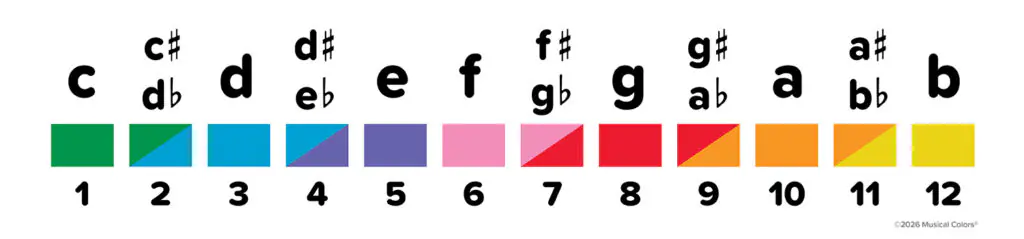
The 12 musical notes arranged by fixed serial numbers in the Musical Colors® color-coded system
Music Theory is the study of how Notes, Scales, and Chords interact — shown here as the Musical Colors® color-coded note sequence.
7 Natural Notes — Solid Spectrum Colors
C
Natural
D
Natural
E
Natural
F
Natural
G
Natural
A
Natural
B
Natural
5 Sharps & Flats — Enharmonic Color Pairs (the Black Keys)
C#/D♭
Enharmonic
D#/E♭
Enharmonic
F#/G♭
Enharmonic
G#/A♭
Enharmonic
A#/B♭
Enharmonic

For a colorful total of 12 piano keyboard notes — that can also be placed on many other musical instruments. Explore all 12 notes →

How Color-Coded Notes Make Music Theory Visual In Real Time

Understanding the Relationships Between Notes, Scales & Chords

Musical Colors® makes music theory visual in real time by assigning every single note its own consistent color or pair of colors placed directly on a musical instrument. Instead of only memorizing abstract note names, scales, and chord shapes, musicians can instantly see patterns, intervals, and overlapping relationships as they play. This unique visual approach transforms any fretboard, keyboard, or fingerboard into an easy-to-understand topological map — helping players instantly recognize scales, build the chords within them, improvise on the fly, and connect an understanding of music theory simply and naturally through color recognition and muscle memory.

Musical Colors® color-coded music theory scales and chord patterns displayed visually
The ultimate in musical information displayed on your instrument — scales, chords, and intervals visible at a glance through color.

Color-Coded Music Theory For Guitar, Piano, Violin And More

How the Same Color System Works Across Many Instruments

Musical Colors® uses the same consistent color-coded visual system across multiple musical instruments, making it easier for musicians to transfer their knowledge and practical experience from one instrument to another. Because each of the 12 notes always shares the same color, music players can quickly recognize musical scales, chords, intervals, and patterns whether they are playing a guitar, a bass guitar, a ukulele, a banjo, a mandolin, a piano, a violin, or pitched percussion instruments like crotales, hand bells, hand chimes, tubular bells, glockenspiel, marimba, xylophone, vibraphone, steel pan, handpan, and tongue drum. This creates a universal language that visually helps musicians learn faster, build confidence, and understand music theory more naturally across their entire instrument.

Color-coded music theory applied across violin and multiple instruments with Musical Colors® system
The same color always means the same note — whether you are playing guitar, piano, violin, ukulele, banjo, mandolin, or percussion.

Click any button below to learn about music notes, scales & chords — or watch some instruction videos:

How It All Connects

Music Theory Is The Study Of How Notes, Scales And Chords Interact

Not three separate subjects — one system viewed from three angles. See how they connect on a color-coded instrument and theory stops being something you study and becomes something you play.

Notes — The 12 Building Blocks
Western music is built from 12 notes — seven natural notes (the white keys of a piano) and five sharps and flats (the black keys). In Musical Colors®, each has a fixed color derived from the mathematical relationship between sound frequencies and light wavelengths. Natural notes carry solid spectrum colors. Sharps and flats carry enharmonic color pairs. The same color appears on every fret, every key, every octave, on every instrument.
See All 12 Notes →
Scales — Patterns You Can See
A scale is a specific selection of notes arranged in a fixed interval pattern. Major scales sound resolved and bright. Minor scales carry more emotional weight. Pentatonic scales drive blues and rock improvisation. With color-coded stickers installed, any scale becomes a visible color pattern across the entire instrument. You can see which notes belong to a key without stopping to calculate. The Playground unlocks 150+ scales including exotic and international tunings.
Explore Color-Coded Scales →
Chords — Notes from Scales Played Together
A chord is built directly from a scale — not a separate concept at all. A major chord takes the first, third, and fifth notes of a major scale. On a color-coded instrument, the notes of any chord are already visible as specific colors inside the scale pattern. The chord shape stops being a memorized finger position and becomes something you can see, understand, and choose consciously — which is the difference between playing music and playing shapes.
Explore Color-Coded Chords →
The Process

Start Learning Music Theory the Visual Color Way with Musical Colors®

Theory you can see is theory you can actually use. Install the stickers, play the instrument, and let the patterns emerge — not the other way around.

1
Install color-coded sticker guides

Every note is immediately visible in its correct color on every fret, key, or fingerboard position. No memorization needed to start — the map is already there.

2
Explore notes, scales and chords by color

Scale patterns appear as color sequences across the whole neck. Chord shapes reveal their component notes by color. See what belongs in any key instantly.

3
Play, improvise, and connect theory to sound

As you play, visual patterns build muscle memory and theoretical understanding simultaneously — through playing, not through studying.

4
Go deeper with the Playground

150+ exotic and international scales, the Circle of Fifths, interactive modulation tools, and music curriculum materials — all built around the same visual color system.

Musical Colors® visual music theory system — scale and chord patterns on instrument The 12 musical notes color-coded by the Musical Colors® system

The 12 musical notes arranged by their fixed serial numbers in the Musical Colors® visual system.

Color-coded music theory across multiple instruments — violin, guitar, piano — using Musical Colors® sticker guides
One System. Every Instrument.

The Same Color System Works Across Many Instruments

Because each of the 12 notes always shares the same color, music players can quickly recognize musical scales, chords, intervals, and patterns whether they are playing guitar, bass, ukulele, banjo, mandolin, piano, violin, or pitched percussion.

This creates a universal visual language that helps musicians learn faster, build confidence, and transfer their music theory knowledge between instruments naturally.

Playground Membership

Join the Playground to Access Our Complete Color-Coded Scale & Chord Library

Including international & exotic scales, interactive resources, downloads, and modulation tools — the complete Musical Colors® theory library built around the same color system you installed on your instrument.

Join the Playground Shop Sticker Guides
Common Questions

Frequently Asked Questions — Music Theory

What is music theory?

Music theory is the study of how notes, scales, and chords interact with each other to create music. It explains the structure behind every piece of music ever written — how notes combine into scales, how scales generate chords, and how those chords create the harmony and melody we hear. Musical Colors® makes this visible in real time by assigning each of the 12 notes a consistent color placed directly on your instrument, so theory becomes something you see while you play rather than something you study before you play.

Why does traditional music theory feel so overwhelming?

Most instruction introduces abstract concepts — interval names, chord symbols, scale degrees — before a student has any visual reference on the instrument for what those words describe. The gap between knowing something on paper and being able to use it in real time is where most people get stuck. Color-coded notes eliminate that gap by making theory visible directly on the fretboard, keyboard, or fingerboard — so theory and playing happen in the same place at the same time.

How does color-coding make music theory easier to understand?

Each of the 12 musical notes is assigned a consistent color derived from the mathematical relationship between sound frequencies and light wavelengths — the same relationship Newton first documented in relation to music in 1704, and that the Science page details fully. When sticker guides are installed, scale patterns become visible color sequences, chord shapes reveal their component notes, and intervals appear as gaps between colors. Theory becomes something you see on the instrument rather than recall from memory.

Does the color system work across different instruments?

Yes. The same color always means the same note — on guitar, bass, ukulele, piano, violin, banjo, mandolin, and pitched percussion. A student who learns note colors on ukulele carries that understanding directly to guitar or piano. A classroom teacher can instruct students on different instruments using the same color vocabulary.

What is the best way to learn music theory for beginners?

Connect theory to your instrument from the start. Install Musical Colors® sticker guides and learn note colors while you play, then explore scale patterns and chord structures as visible color sequences rather than memorized lists. Most beginners identify all 12 notes by color within the first week. The Music Theory for Beginners guide walks through the full practical sequence.

Can Musical Colors® help with improvisation?

Improvisation requires seeing which notes belong to your scale in real time — faster than you can calculate. With color-coded sticker guides on your instrument, the scale is visible as a color pattern across the entire neck. You can see which notes to play without stopping to think about it. The Musical Colors® system was originally developed in 1991 specifically to solve this problem — the founder needed a way to improvise on guitar and stay in key without losing the thread between theory and playing.

As Featured In

Start Learning Music Theory the Visual Color Way with Musical Colors®

Get the color-coded sticker guides for your instrument and see every note, every scale, and every chord in real time — on the fretboard, keyboard, or fingerboard in front of you.

Upgrade Now — Shop Guides Join the Playground